Today we’re introducing Prism 1.1, the next version of our model for finding private data in text.
Prism 1.1 comes in three sizes: small, base and multi. It finds more private data than Prism 1 on 8 of the 10 public benchmarks we ran both models on. The biggest gains are on long documents, chat conversations and text in many languages.
We tested it the hard way. We ran Prism 1.1 and 9 other systems on 11 public benchmarks covering 18,681 documents, and gave every system the same documents and the same scoring rules. All the scores are below.
What Prism does
Think of Prism as a careful reader with a highlighter.
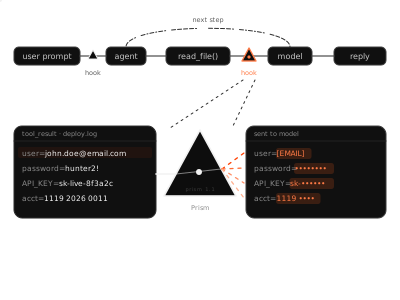
You give it a piece of text, like an email, a chat with an AI assistant, a support ticket or a long contract. Prism reads it and highlights the private parts: people’s names, phone numbers, home addresses, ID numbers, card numbers, passwords and API keys.
Once those parts are highlighted, they can be hidden or replaced before the text is saved, shared or sent to an AI model. The rest of the text stays useful.
The hard part is telling real private data apart from text that only looks like it. “Call me on 555-0100” contains a phone number. “Phone numbers have ten digits” does not. A good model needs to understand the difference, not just match patterns.
What’s new in Prism 1.1
It finds more. Compared with Prism 1, Prism 1.1 scores higher on 8 of the 10 public benchmarks both models were tested on.
It reads long documents better. Private data often sits deep inside a long file. On RedactionBench, a set of long documents, Prism 1.1 scores 70.4, up from 59.6 for Prism 1. On European court judgments (TAB), it rose to 84.1, up from 78.8.
It gets whole names right. Finding most of a name is not the same as finding all of it. On court judgments, the share of names Prism 1.1 marked with exactly the right start and end went from 14.6 to 56.5.
It handles conversations and work messages. On multi-turn chats with an AI assistant (PII-TRACE), Prism 1.1 scores 81.5, up from 77.8. On workplace email and chat (PrivacyBench) it scores 94.8, up from 92.4.
It works across languages. Prism 1.1 multi is built for text in many languages. On REDACT, which covers 25 languages, it scores 82.7, up from 79.6.
How we tested it
A score only means something if everyone takes the same test. So we built one test harness and ran every system through it.
11 public benchmarks. They include made-up personal records, real enterprise-style documents, text in 25 languages, chats with AI assistants, workplace email, court judgments, long documents and leaked passwords in GitHub issues.
Same rules for everyone. Every system saw the same documents. Every system’s labels were mapped to the same list of private data types, and one scorer graded them all.
Two kinds of score. Both are F1 scores out of 100, where higher is better:
- Character F1 asks: how much of the private text did the system find, without flagging too much that wasn’t private?
- Exact span F1 is stricter. It asks: did the system find each whole value, like a full name or a full card number, with exactly the right start and end?
No home advantage. Some of the competing systems in our comparison were trained on data from a benchmark they’re being tested on. Their scores on that benchmark are shown in grey and left out of the ranking, because it’s like seeing the exam before taking it.
The results
The two tables below show how Prism 1.1 compares with nine other PII detectors across all 11 benchmarks. In each row, the highlighted cell is the top score.
Across all of these systems, leaving out any that were trained on a benchmark’s data, Prism 1.1 leads or comes within a point of the leader on five results:
- Best exact span F1 on REDACT (25 languages): Prism 1.1 multi scores 58.0, ahead of GLiNER2-PII (57.9) and Perplexity PII-Tracer (52.7).
- Tied best character F1 on PrivacyBench (workplace email and chat): Prism 1.1 base scores 94.8, level with Perplexity PII-Tracer.
- Within a point on REDACT character F1: Prism 1.1 multi scores 82.7, against 83.7 for Perplexity PII-Tracer.
- Within a point on TAB court judgments: Prism 1.1 multi scores 84.1, against 85.0 for Perplexity PII-Tracer.
- Within a point on PIIBench exact span F1: Prism 1.1 small scores 45.3, against 45.8 for CobuildX PII.
Why Prism
Accuracy is only part of the story. Prism is also built to be practical to run.
Smaller than most of the field. Prism 1.1 small has 74 million parameters. Several systems in our comparison are many times larger: NVIDIA GLiNER-PII has 570 million, Perplexity PII-Tracer has 600 million and OpenAI Privacy Filter has 1.5 billion.
Light on memory and disk. A smaller model needs less memory to run and less space to store. Here is how big each model’s weights were when we downloaded them for testing:
| Model | Parameters | Weights on disk |
|---|---|---|
| Prism 1.1 small (Q4) | 74M | 47 MB |
| Prism 1.1 small (INT8) | 74M | 43 MB* |
| Prism 1.1 small | 74M | 296 MB |
| Prism 1.1 base | 194M | 774 MB |
| Prism 1.1 multi | 287M | 1.1 GB |
| Perplexity PII-Tracer | 600M | 1.1 GB |
| GLiNER2-PII | 307M | 1.2 GB |
| NVIDIA GLiNER-PII | 570M | 1.7 GB |
| OpenAI Privacy Filter | 1.5B | 5.2 GB |
* The INT8 build keeps its word list (the embedding table) in a separate file that is read from disk as needed, not loaded into memory.
Runs on your own hardware. Prism runs on the machine where your data already lives: Apple silicon through MLX, or any regular CPU through ONNX. It doesn’t need a cloud API, so the text you check never has to leave your device.
Reads long documents from start to finish. Some GitHub issues in our tests were more than 200,000 characters long. Prism 1.1 read every one of them.
Stays accurate when compressed. The two compressed builds of Prism 1.1 small, Q4 and INT8, score within a point of each other on 9 of the 11 benchmarks. You can pick the smaller build without giving up much accuracy.
Pick the right size
All three sizes find the same kinds of private data. They trade size for accuracy.
- Small (74M parameters) is the lightest. It comes in two builds: Q4 for Apple silicon, whose weights are about 47 MB, and INT8 for ONNX. The two builds score within a point of each other on 9 of the 11 benchmarks.
- Base (194M parameters) is the strongest on documents and workplace text. It leads the Prism 1.1 family on RedactionBench (70.4) and PrivacyBench (94.8).
- Multi (287M parameters) is the one to pick for text in many languages. It leads the family on REDACT’s 25 languages (82.7).
Get access
Prism 1.1 is now in internal testing as part of Project Horizon. A detailed model card is coming soon.
Prism is built to support people, not replace them. It works best as one layer in a safety setup that also includes policy rules, logging and human review.
If your team handles sensitive data in AI products, support tools or security workflows and wants early access, we’d like to hear from you.